
Ukraine, 3-6-23

First, links to reports from National Public Radio, the Associated Press, Reuters, and Tass; others are accessible by clicking on their names or initials below. Finally for today, a link to an article of analysis from the Unz Review. — MCM

–   –   –

In the Donbas, Russia’s vast numbers of troops weigh heavily on Ukraine’s defenders. Reported by Frank Langfitt | NPR  KRAMATORSK, Ukraine — The Russian and Ukrainian armies have burned through many of their best soldiers in the past year of war. Both sides now rely heavily on conscripts. Andriy, a  Ukrainianreconnaissance team leader, says the problem is that Russia has far more troops than Ukraine, and even young, inexperienced men pose a challenge simply by virtue of their numbers. “The Russian mobilizational reserve is pretty much infinite,” he says, “which means . . . Click HERE to listen and read.

–   –   –

Ukraine unyielding in Bakhmut as Russian troops close in. From AP. KYIV — Ukrainian military leaders are determined to hold onto Bakhmut, Kyiv officials said today, even as Russian forces continued to encroach on the devastated eastern Ukrainian city. More broadly, Russia continues to experience difficulty generating battlefield momentum. Moscow’s . . . READ MORE . . .

–   –   –

Kyiv says forces are holding on in ‘hellish’ Bakhmut battle, by Nick Starkov | Reuters  * Bakhmut defence is holding, says Ukrainian officer * Pentagon boss Austin plays down strategic value of Bakhmut * Wagner boss says aide barred from operational HQ as row swirls | KYIV — Kyiv said today its troops were still holding out in a “hellish” fight for Bakhmut, while Washington said that even if the eastern Ukrainian city should fall to a Russian offensive, it would not necessarily give Moscow momentum in the war. In the latest sign of a feud between Russia’s military and the Wagner private army leading its Bakhmut assault, Wagner’s boss demanded . . . READ MORE . . .

–   –   –

Russia aims to capture Bakhmut, for its first important battlefield victory in months. Reported by A Martínez and Joanna Kakissis | NPR  Russian and Ukrainian forces have been fighting over the eastern Ukrainian city of Bakhmut. Both sides have suffered horrific losses. Russia is trying to encircle Ukrainian forces still in the city. Click HERE to listen and, later, read.

–   –   –

Deja vu: Ukrainian forces trapped in Artyomovsk evoke memory of Debaltsevo – DPR adviser. From Tass. MOSCOW — The encirclement in Artyomovsk (a town known in Ukraine as Bakhmut) harkens back to how Ukrainian forces were trapped in Debaltsevo in 2015, Yan Gagin, an adviser to interim head of the Donetsk People’s Republic Denis Pushilin, said today. “Practically everything,” he said, “is under the control [of Russian forces]. This, one can say, is practically a new cauldron, which . . . READ MORE . . .

–   –   –

Direct talks between Russia, U.S. are needed to settle conflict in Ukraine – Hungarian FM. From Tass. BUDAPEST — Hungary believes the settlement of the armed conflict in Ukraine requires direct talks between Russia and the U.S., Hungarian Foreign Minister Peter Szijjarto said today. “We would welcome direct talks . . . READ MORE . . .

–   –   –

Italy’s prime minister supports Ukraine — causing tension within her coalition. Reported by Sylvia Poggioli | NPR  Italian Prime Minister Giorgia Meloni is known for her far-right domestic policies, but she is supporting Ukraine. However, some of her coalition partners do not. Click HERE to listen and, later, read.

–   –   –

Japan and South Korea address a dispute over their bitter past. Reported by Anthony Kuhn | NPR  South Korea’s government is introducing a new plan to resolve historical disputes with Japan, and compensate Koreans for the forced labor imposed by Tokyo’s 35-year colonial rule. Click HERE to listen and, later, read.

–   –   –

War and propaganda in the Russia-Ukraine conflict, by Ron Unz | The Unz Review The Wall Street Journal on Feb. 25 published a lengthy review by Yaroslav Trofimov of the twelve months of the conflict, summarizing what had happened and describing future prospects (Ukraine is the West’s war now). The writer noted that America and its allies had already provided Ukraine with an astonishing $120 billion in military equipment and money, a figure far larger than Russia’s entire defense budget, with further massive . . . READ MORE . . .

Ukraine, 3-5-23

First, links to reports from the Associated Press, Tass, and Reuters; others are accessible by clicking on their names or initials below. Next, via Popular Resistance, a link to an analysis from LA Progressive. Then, a link to a political cartoon. — MCM

–   –   –

Civilians flee embattled town as Ukrainian pullout looms, by Mstyslav Chernov | AP  KHROMOVE, Ukraine — Pressure from Russian forces mounted Saturday on Ukrainians hunkered down in Bakhmut, as residents attempted to flee with help from troops who Western analysts say may be preparing to withdraw from the key eastern stronghold. A woman was killed and two men were badly wounded by . . . READ MORE . . .

–   –   –

Russian air defense systems shoot down Mi-8 helicopter, six HIMARS and Smerch MLRS shells. From Tass. MOSCOW — Russian air defense systems have shot down a Mi-8 helicopter, intercepted six HIMARS and Smerch MLRS shells, and destroyed 12 drones of the Armed Forces of Ukraine over the past day, official representative of the Russian Defense Ministry, Lieutenant-General Igor Konashenkov announced today.

–   –   –

Russian forces hit command post of Azov nationalist regiment in Zaporozhye region. From Tass. MOSCOW — Russian troops hit the command post of the nationalist regiment Azov (banned in the Russian Federation) in the Zaporozhye region near the village of Maryevka, official representative of the Russian Defense Ministry, Lieutenant-General Igor Konashenkov announced today.

–   –   –

Estonia votes in election test for pro-Kyiv government. From Reuters. TALLINN — Estonians headed to the polls today in an election pitting one of Europe’s most staunchly pro-Kyiv governments against a far-right party seeking to capitalise on anger at rising living costs and which would stop admitting new Ukrainian refugees. If, as . . . READ MORE . . .

–   –   –  

Ukraine war one year in, by Jack Rasmus| LA Progressive It has been roughly a year since Russia invaded Ukraine on Feb. 24, 2022. A month before that invasion, in January 2022, this writer published an article ’10 Reasons Why the U.S. May Want Russia to Invade Ukraine.’ In that prior article it was argued the U.S. had much to gain economically and geopolitically by provoking Russia to invade. The article went on . . . READ MORE . . .

–   –   –  

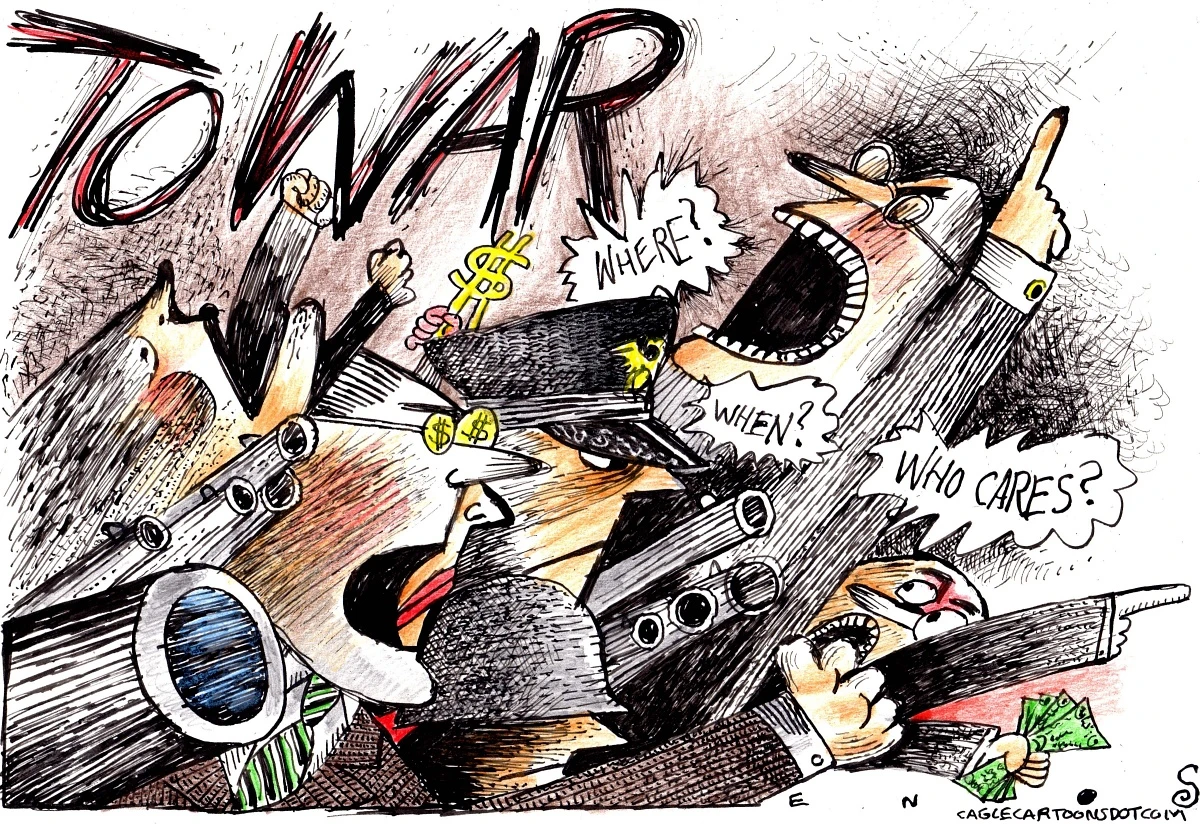
The political cartoon the LA Progressive used to illustrate article published before war began, referred to in article just above, by Daryl Cagle | caglecartoons.com Click HERE for it.

–   –   –

MAY BE CONTINUED

Ukraine, 3-4-23

First, links to reports from Reuters, Tass, National Public Radio, Agence France-Presse, and the Associated Press; others are accessible by clicking on their names or initials below. Then, a TV report rare for this blog, broadcast on Feb. 28 by NBC News. — MCM

–   –   –

Russia close to encircling Ukraine’s Bakhmut after months of fighting, by Leonardo Bennasatto and Lisi Niesner | Reuters  * Russian mercenary chief says one route only out of Bakhmut * Ukraine national guard says situation ‘critical’ * Biden and Germany’s Scholz meet to discuss support for Ukraine | CHASIV YAR, Ukraine — Russian artillery pounded the last routes out of Bakhmut on Friday, aiming to complete the encirclement of the besieged Ukrainian city. A Russian victory in Bakhmut, with a pre-war population of about 70,000, would give it . . . READ MORE . . .

–   –   –

U.S., Germany to impose costs on Russia as long as needed – White House. From Tass. WASHINGTON — U.S. President Joe Biden and German Chancellor Olaf Scholz expressed their readiness to continue the policy of sanctions against Russia “as long as necessary,” the White House’s press service said. The two “discussed ongoing efforts to provide security, humanitarian, economic, and political assistance to Ukraine and the importance of maintaining global solidarity with the people of Ukraine,” the White House said. “They . . . READ MORE . . .

–   –   –

Ukraine prepares for an ongoing defense on its border with Belarus. Reported by Joanna Kakissis | NPR  Along a quiet but unpredictable border, Ukrainian soldiers are digging in for a protracted war and training to help besieged forces in the east. Click HERE to listen and read.

–   –   –

Russian defence minister inspects front, U.S. puts up new Ukraine aid. From AFP. MOSCOW — Russia’s defence minister has inspected the frontline in east Ukraine, after the United States offered More support to Kyiv, whose forces are struggling in eastern Bakhmut. Sergei Shoigu “inspected a command post on the front” in the direction of the southern Donetsk region, the defence ministry said, without specifying . . . READ MORE . . .

–   –    –

Ukraine plant builds 6-person bunkers for war’s front lines, by Hanna Arhirova | AP  KRYVYI RIH, Ukraine — At a steel plant in the central Ukraine city of Kryvyi Rih, some workers have switched from doing their usual jobs producing and repairing mining equipment to building metal bunkers for front-line troops. Ukrainian mining and metals company Metinvest . . . READ MORE . . .

–   –   –

A view from Crimea, the Russian-annexed territory Ukraine is hoping to seize back. Reported by Keir Simmons, Natasha Lebedeva and Tatyana Chistikova | NBC News SEVASTOPOL — Crimea is a territory teeming with Russian forces. Nowhere is that truer than in Sevastopol, a city that has long embodied naval might in the Russian imagination. But this is not Russia, according to Kyiv, its Western allies and the United Nations. It was annexed by the Kremlin in 2014, with the U.N. calling on Russia to return to its “internationally recognized borders.” President Volodymyr Zelenskyy has vowed Ukraine will . . . Click HERE to read and to watch.

–   –   –

TO BE CONTINUED

Ukraine, 3-3-23

First, links to reports from National Public Radio, Agence France-Presse, Tass, Reuters, and the Associated Press; others are accessible by clicking on their names or initials below. — MCM

–   –   –

Germany’s chancellor is visiting President Biden at the White House. Reported by Steve Inskeep and Rob Schmitz | NPR Chancellor Olaf Scholz is traveling without press and the two leaders do not plan to have a news conference. His visit may focus on the tense rhetoric between the U.S. and China. Click HERE to listen and, later, read.

–   –   –

U.S., Germany aim to deter China from supplying Russia with weapons against Ukraine. Steve Inskeep of NPR talks with Jeff Rathke of the American Institute for Contemporary German Studies about the issues the U.S. and Germany agree on, and where they differ. Click HERE to listen and, later, read.

–   –   –

Russia warns against more Western arms for Ukraine ahead of Biden, Scholz meeting. From AFP. The Kremlin toiday warned Western countries against providing more arms to Ukraine as key Kyiv backers President Joe Biden and German Chancellor Olaf Scholz were set to meet in Washington. “It is obvious,” Kremlin spokesman Dmitry Peskov said, “that this will prolong the conflict and have sad consequences for the Ukrainian people.” READ MORE . . .

–   –   –

Lavrov says Russia will no longer rely on West in energy policy. From Tass. NEW DELHI — Russia will no longer rely on Western partners in its energy policy, Russian Foreign Minister Sergey Lavrov said today. “Of course, the war that we are attempting to end and that was started by the West against us using Ukrainians . . . READ MORE . . .

–   –   –

Russian mercenary boss says Bakhmut practically surrounded, by Leonardo Bennasatto and Lisi Niesner | Reuters. * Wagner chief says only one route out of Bakhmut left open * Ukraine national guard says situation there ‘critical’ * Ukrainian forces digging trenches west of the city * Biden, Scholz to discuss weapons for Kyiv | CHASIV YAR, Ukraine — Russian troops and mercenaries were closing off the last access routes to the besieged Ukrainian city of Bakhmut today, on the cusp of Moscow’s first major victory in half a year after the bloodiest fighting of the war. The head of Russia’s Wagner private army, Yevgeny Prigozhin, said the city, which . . .  READ MORE . . . 

–   –   –

A year into Ukraine war, bodies dug up in once occupied town, by Elena Becatoros | AP  BORODYANKA, Ukraine — Ukrainian authorities are still unearthing people who were hastily buried in makeshift gravesduring Russia’s brief but brutal occupation of villages and towns near Kyiv. Almost 200 bodies remain unidentified, while 280 people are listed as missing. Halyna Pinchuk is among them. They never found . . . READ MORE . . .

–   –   –

Aircraft downed above Yenakiyevo in DPR, mayor says. From Tass. DONETSK — An aircraft has been downed over Yenakiyevo in the Donetsk People’s Republic (DPR), Mayor Roman Khramenkov reported today. Both pilots successfully ejected, but there was no understanding yet as to the origin of the aircraft, he added. Yenakiyevo is located . . . READ MORE . . .

–   –   –

The role of cyber weapons in Russia’s war on Ukraine. Reported by Jenna McLaughlin | NPR  Ukrainian officials say they have been fighting the first “hybrid war,” in cyberspace and on the ground. A year in, digital tools remain an important — if ambiguous — component of the conflict. Click HERE to listen and read.

–   –   –

MAY BE CONTINUED

Ukraine, 3-2-23

First, links to reports from Reuters, the Associated Press, National Public Radio, Agence France-Presse, and Tass; others are accessible by clicking on their names or initials below. — MCM

–   –   –

U.S., allies in war of words with Russia at G20 meet, by Krishn Kaushik and Simon Lewis | Reuters  * U.S. and allies row with Russia at G20 ministers meet * Blinken says meeting has been marred by Russia * Lavrov says work on G20 agenda has been turned into a ‘farce’ * Italy’s PM asks India to facilitate ‘just peace’ in Ukraine | NEW DELHI, March 2 (Reuters) – The U.S. and its European allies sparred with Russia on Thursday over the war in Ukraine and urged the Group of 20 (G20) nations to keep up pressure on Moscow to end a conflict that they said had destabilised the world. Russia hit back, accusing the West . . . READ MORE . . .

–   –   –

Blinken, Lavrov meet briefly as U.S.-Russia tensions soar, by Matthew Lee | AP  NEW DELHI — U.S. Secretary of State Antony Blinken and Russian Foreign Minister Sergey Lavrov talked briefly today at a meeting of top diplomats from the Group of 20 nations in the first high-level meeting in months between the two countries. U.S. officials said the two chatted for roughly 10 minutes on the sidelines of the conference in New Delhi. Relations between Washington and Moscow have . . . READ MORE . . .

–   –   –

U.S. and Russia’s top diplomats meet at G-20 summit. Reported by Leila Fadel and Charles Maynes | NPR  The brief talks marked the first face-to-face meeting between Secretary of State Antony Blinken and his Russian counterpart, Foreign Minister Sergey Lavrov, since Russia’s invasion of Ukraine. Click HERE to listen and, later, read.

–   –   –

India confirms no joint G20 statement due to Ukraine divisions. From AFP. Indian Foreign Minister S. Jaishankar said today’s G20 meeting in New Delhi had been unable to reach a joint declaration owing to divisions over the war in Ukraine. “On the issue, which very frankly concerned the Ukraine conflict, there . . . READ MORE . . .

–   –   –

Russia claims Ukraine crossborder sabotage raid; Kyiv denies, by Susie Blann | AP  KYIV — Russian officials today accused Ukrainian saboteurs of crossing into western Russia and attacking local villages, an accusation Ukraine denied and alleged would be used by Moscow to step up attacks. If confirmed, it would be another indication following drone attacks earlier this week that Kyiv . . . READ MORE . . .

–   –   –

Official expects Russian troops to take Artyomovsk in near future. From Tass. MOSCOW — Russian forces will soon close the encirclement around the city of Artyomovsk (called Bakhmut in Ukraine), head of the Russian delegation to the Vienna talks on military security and arms control Konstantin Gavrilov said today. He also said “about 20,000 mercenaries” from NATO countries, namely Poland, were along that part of . . . READ MORE . . .

–   –   –

TO BE CONTINUED

Hersh, 3-1-23

Beginning below, an essay by a writer best known since Dispatch News Service in 1969 distributed his first story on the Mi Lai massacre in Vietnam, which had taken place the year before.  — MCM

–   –   –

Does it take a war?

By Seymour Hersh

There is an inevitable gap between what a president tells us about a war— even a proxy war — and the reality on the ground. It is true today as Joe Biden struggles for public support for the war in Ukraine, and it was true six decades ago as Jack Kennedy struggled to understand the war he chose to pursue in South Vietnam.

Early 1962 was a critical time for President John F. Kennedy. After his image and leadership had been tarnished by the Bay of Pigs disaster three months into his term, he had decided that he must make a stand in South Vietnam and confront the spread of communism there. The president spent the rest of 1961 secretly increasing American defoliation, bombing, and the number of US troops inside South Vietnam. His fight against international communism was on. His foil was Soviet leader Nikita Khrushchev, who had overwhelmed the young president at a summit meeting on June 4, 1961, with his knowledge, toughness, and lack of respect for Kennedy’s floundering in Cuba. “So he just beat the hell out of me,” the president later told New York Times columnist James Reston.

Nonetheless, America was smitten by the glitz and glamor of Jack and Jackie and their life inside the White House, with parties and social events that brought together the best America had to offer from the worlds of music, the arts, and the academy. So it was that David Herbert Donald, the most prominent Lincoln scholar of his time, found himself asked to give a private briefing in the White House. The small group he addressed—it numbered no more than twenty—included longtime friends of the president and some key members of his government. Donald would be the guest of the president and his wife. He was delighted.

Donald, who had won a Pulitzer Prize that year for his work on the Civil War, wrote a long chatty letter to an old friend a few weeks later about his night at the White House. I learned of the meeting during the 1990s while researching a book on the Kennedy Administration. Donald sent me a copy then of the letter, but urged me to publish very little of it in my book. I did what he asked. Donald died in 2009, after decades of teaching American history at Harvard University, and I’d like to think he would have approved of my quoting it at greater length here.

Donald reported in the letter that he talked for forty minutes about the difficulties of Reconstruction after the Civil War, and the trouble he and other historians were having, as he wrote, “in writing a new synthesis of the period.” There was a long period of chatter, with both the president and his wife Jacqueline actively participating. “Mrs. Kennedy,” Donald reported, was “extremely simple and unassuming, very young, very shy, and a little unsure of herself. . . . That radiant beauty which appears in her photographs and in her television appearances is not apparent, but she strikes me as an enthusiastic and highly intelligent young woman.”

The letter went on: “The President himself, too is far less handsome than his pictures. . . . The boyish look which his photographs give him is simply not there. . . . [H]e led off the questioning and continued very active in the discussion throughout; and afterward we had a long, private discussion. It is clear that this is a man determined to go down in our history books as a great President, and he wants to know the secret.

“One thing he said troubled me considerably,” Donald wrote. In discussing the great presidents, Kennedy “asked whether, in sum, did [it] not take a war to put a man in that category? I firmly denied this. He seemed to agree and, since he is bent on being a great President, I hope he really did.”

In a brief telephone conversation I had with Donald in 1996, two decades after the American debacle in Vietnam, the professor expressed far more concern about Kennedy’s view of greatness. He told me that Kennedy was fascinated with Lincoln and Franklin Roosevelt because “he thought to be a great President you had to be a wartime President. That was scary to me. I came away feeling that this was a young man who doesn’t understand history.”

Donald’s chat with Kennedy came — as the professor could not have known at the time — at a crucial early moment in Vietnam. The president had continued moving, in secret, to increase dramatically the number of American military men flooding in the South under the guise of special advisors. He also was fascinated by the derring-do of those who fought in World War II in undercover units organized by the Office of Strategic Services. OSS agents often worked in enemy zones in Europe and Asia with partisans and guerrillas. The head of intelligence for the State Department at the time was Roger Hilsman, an army officer who saw combat and later served undercover with the OSS in Burma. After the war, Hilsman joined the newly formed Central Intelligence Agency. He left the Agency to get a doctorate in political science at Yale University. Now, in the early days of the Kennedy Administration, he had special caché at the State Department. He had been wounded in battle and was part of a team that liberated American prisoners, including his own father, from a Japanese prisoner of war camp.

With his experience, confidence, and academic credentials, Hilsman became a favorite of the president and his brother Robert, the attorney general, and both became avid supporters of an innovative solution that Hilsman was advocating. The plan promised to resolve a vexing issue of the war: how to separate the anti-government and pro-communist guerrilla fighters known as the Viet Cong from the peasant villagers who, willingly or not, provided them with food, protection and support. Known as the Strategic Hamlet Program, the concept won immediate approval from the US and South Vietnamese military as well from those Americans seeking more social programs for the peasantry. “It was Kennedy’s last hope for winning hearts and minds,” I was told years ago by an American intelligence expert. The historian Christian G. Appy, in American Reckoning, an incisive study of the limits of American exceptionalism, described the project that emerged as “a coercive plan that forced villagers off their land and relocated them in armed camps. . . . What they [Kennedy, Hilsman and the White House advisors] did not take into account was how the villagers might feel about being forcibly removed from their ancestral lands and stuck in fortified compounds behind barbed wire.”

I had learned firsthand about the ignorance and cruelty of forced peasant relocation while reporting on the My Lai massacre in 1969. The massacre had taken place in March of 1968 and most of the GIs involved had finished their tour of duty in the war and were back home — at work, in school, or doing nothing. The Strategic Hamlet Program was long gone but villagers in some contested areas were still being forced off their lands into resettlement areas to enable the American military to slaughter all who refused to leave with impunity. The evacuated areas were designated Free Fire Zones. My Lai was not such an area. Some of the GIs who had participated in the murders and rapes at My Lai justified their brutality by telling me, with much contempt, about how the mothers in Vietnam, when being evacuated from their native villages, insisted on being the first to hop onto the waiting helicopters. I was told again and again by GIs, who had grown up in a culture that called for children to go first, that they had to beat the mothers—sometimes violently with the butts of their rifles—to allow the children to board first. None of the GIs had been told that in Vietnamese society the mother always crosses a new threshold first, to assure that all who follow will be safe. 

The Strategic Hamlet Program was a disastrous, and mysterious, failure for the young Kennedy Administration, and it hardened the resolve of the peasant population against the American interlopers. Jack Kennedy did not live . . . Subscribers to Substack may click HERE and read more.

‘Dark side,’ 3-1-23

Virtual attendees of the Rage Against the War Machine rally in Washington, HERE, can judge for themselves whether an English band member’s contribution was the best of the 24 or so speakers’. First below, a link to a National Public Radio report concerning the band’s best-known album. Then, a link from genius.com to opening lyrics of one of the album’s songs. Next, a link to a Rolling Stone article on the album, its making, and its successes. Finally for now, a link to a World Socialist Web Site review of the Washington rally. — MCM

–   –   –

Psychologist Daniel Levitin dissects Pink Floyd’s ‘Dark Side of the Moon.’ Reported by Leila Fadel, Phil Harrell and Chad Campbell | NPR  Here’s an enduring legacy: Pink Floyd‘s album Dark Side of the Moon, released 50 years ago today and still on the Billboard charts, can be enjoyed for its far-out sonic landscapes or its inventive production. You can also study . . . Click HERE to listen or the report, and perhaps later to read more.

–   –   –

Breathe . . .  From genius.com. “Breathe, breathe in the air. Don’t be afraid to care. Leave, but don’t leave me. Look around and choose your own ground . . . .” Beginning lyrics of a song in the “Dark Side of the Moon” album. Click HERE for more.

–   –   –

Pink Floyd’s ‘Dark Side of the Moon’: 10 things you didn’t know, by Dan Epstein | Rolling Stone There are hit albums, and then there’s . . . READ MORE . . .

–   –   –

The ‘Rage Against the War Machine’ rally: A reactionary political freak show, by Jacob Crosse and Joseph Kishore | WSWS The “Rage Against the War Machine” rally held on Feb. 19 in Washington, D.C., was a political freak show attended by a motley crowd of several hundred Libertarian Party supporters, neo-fascists, and disoriented and demoralized middle-class individuals without an independent program or perspective. The speeches, many of which were obscenity-laced rants, were pitched to the lowest political level. By the time the event finally dribbled to an end, it had left . . . READ MORE . . .

–   –   –

MAY BE CONTINUED

Ukraine, 3-1-23

First, links to reports from the Associated Press, Agence France-Presse and Le Monde, Tass, Reuters, and National Public Radio; others are accessible by clicking on their names or initials below. NOTE: Repairs have been made to the “Not all the rage” entry of two days ago in which several asterisks in front of names of speakers were either not linked to the speakers’ addresses or not highlighted, or both. The link is HERE.— MCM

–   –   –

Ukraine official: Forces may pull out of key eastern city, by Susie Blann | AP  KYIV — The Ukrainian military might decide to pull troops back from the key stronghold of Bakhmut, an adviser to Ukraine’s president said today. “Our military is obviously going to weigh all of the options. So far, they’ve held the city, but if need be, they will strategically pull back,” said Alexander Rodnyansky, an economic adviser to Ukrainian President Volodymyr Zelenskyy. The battle for Bakhmut has . . . READ MORE . . .

–   –   –

Blinken says ‘no plans’ to meet Russia, China at G20. From Le Monde and AFP. U.S. Secretary of State Antony Blinken said today he will not meet the Russian or Chinese foreign ministers at this week’s Group of 20 meeting in New Delhi, charging that Moscow was not serious about ending the war in Ukraine. “I have no plans to see either at the G20,” he said in Tashkent, adding that he expected to participate in group sessions with them. READ MORE . . .

–   –   –

Germany’s Scholz argues Russia must be first to take steps towards peace in Ukraine. From Tass. BERLIN — The German government thinks that Russia should be the first to take a step towards achieving peace in Ukraine, Chancellor Olaf Scholz said today. In a joint press conference with Latvian Prime Minister Krisjanis Karins, he said it was “clear” that Russia had attacked Ukraine, and that Russia was the country that “must do something” to make peace possible. Scholz stated . . . READ MORE . . .

–   –   –

Soils of war: The toxic legacy for Ukraine’s breadbasket, by Rod Nickel | Reuters Scientists looking at soil samples taken from the recaptured Kharkiv region in northeastern Ukraine found that high concentrations of toxins such as mercury and arsenic from munitions and fuel are polluting the ground. Using the samples and satellite imagery, . . . READ MORE . . .

–   –   –

How Russia’s war in Ukraine is changing the world’s oil markets. Reported by Jackie Northam | NPR  Russia’s war in Ukraine is causing a profound and permanent shift in the world’s oil markets, creating new geopolitical alliances. Analysts say it’s comparable to the 1970s Arab oil embargo. Click HERE to listen and read. 

–   –   –

TO BE CONTINUED

Ukraine, 2-28-23

First, links to reports from Reuters, the Associated Press, National Public Radio, Tass, and Agence France-Presse; others are accessible by clicking on their names and initials below. Then, links to four recent articles in the Wall Street Journal, one of which was the subject of an article, HERE, by the editor of Consortium News. Also see, just below this entry, or HERE, links to speakers at the Rage Against the War Machine rally in Washington on Feb. 19. — MCM

–   –   –

Russians tighten noose on Ukraine’s Bakhmut, Putin warns of Western espionage, by Dan Peleschuk | Reuters  * Early spring thaw turns battlefields to mud * Russian forces advance north and south of Bakhmut * Kremlin: Kyiv must accept loss of lands annexed by Russia * U.S. Treasury Secretary Yellen visits Kyiv, pledges more aid | KYIV — Russian forces today pressed forward their weeks-long drive to encircle and capture the eastern Ukrainian city of Bakhmut, where the commander of Ukraine’s ground forces described the situation as “extremely tense”. Capturing Bakhmut, scene of . . . READ MORE . . .

–   –   –

Ukraine’s northeastern front could decide new battle lines, by Samya Kullab | AP  KUPIANSK, Ukraine — “Synchronization will be important to halt Russian offensives toward Ukrainian defensive lines,” says Col. Petro Skyba, a battalion commander of the 3rd Separate Tank Iron Brigade. Grueling artillery battles have stepped up in recent weeks in the vicinity of Kupiansk, a strategic town on the eastern edge of Kharkiv province by the banks of the Oskil River. The Russian . . . READ MORE . . .

–   –   –

A look at Russia’s information war on Ukraine. Reported by Shannon Bond | NPR  In the year since Russia invaded Ukraine, the conflict has played out on the battlefield of information, too. Russia is using social media, traditional media and allies to push false narratives. Click HERE to listen and read.

–   –   –

UAV crashes in Kolomna district of Moscow Region, no damage caused – governor. From Tass. MOSCOW — An unmanned aerial vehicle (UAV) has crashed near the village of Gubastovo in the Kolomna district of the Moscow Region. There is no threat to the safety of local residents, the Moscow Region’s governor, Andrey Vorobyov, said today. “Apparently, a civilian infrastructure facility was its target,” he said. “The facility . . . READ MORE . . .

–   –   –

Moscow says downed Ukraine drones targeting civilian infrastructure in Russia. From AFP. Moscow said today its forces downed two Ukrainian drones that had targeted civilian infrastructure in southern Russia, the latest in a series of drone incidents inside Russia that Moscow blamed on Kyiv. “The Kyiv regime attempted to use unmanned aerial vehicles (UAV) to attack civilian infrastructure in the Krasnodar region and the Adygea Republic. The UAVs were neutralised by . . . READ MORE . . .

–   –   –

Drones are giving Ukraine a wartime edge, by Jillian Kay Melchior | The Wall Street Journal Discussion about the war in Ukraine has focused recently on whether the West will supply Kyiv with tanks and jets. But consider the humble drone. Even as Russia has used Iranian-made drones to attack . . .Subscribers to the newspaper may read more.

–   –   –

The Ukraine war lesson Europe refuses to learn, by Joseph C. Sternberg | The Wall Street Journal European voters and politicians haven’t seriously discussed the question of what they are prepared not to do — in terms of social welfare projects, green-energy boondoggles or the like — to pay for Ukraine’s defense. Expect this argument to become . . . Subscribers to the newspaper may read more.

–   –   –

Ukraine’s missing soldiers hint at war’s bloody toll, by Isabel Coles and Ievgeniia Sivorka | The Wall Street Journal DNIPRO, Ukraine — After a year of fighting, Western officials put the number of dead and wounded Ukrainian soldiers at around 100,000, nearly twice the number of U.S. casualties in Iraq and Afghanistan since 9/11. The heavy toll that points to . . . Subscribers to the newspaper may read more.

–   –   –

Switzerland becomes stumbling block for Western military aid to Ukraine. From the Wall Street Journal. The Alpine nation is a major arms exporter, but its reluctance to authorize transfers of ammunition to Kyiv is frustrating . . . Subscribers to the newspaper may read more.

–   –   –

MAY BE CONTINUED