
Ukraine, 11-16-22

First, links to reports from the Associated Press, Reuters, Tass, Agence France-PRESSE, and National Public Radio; others are accessible by clicking on their names or initials below. Then, links to reports from two overtly partisan sources. Last, via Consortium News, another link to the same analysis of a bill before the U.S. Senate Armed Services Committee that appeared in this blog yesterday; on some computer screens it may be more legible. — MCM

–   –   –

Ukraine backers get behind probe of missile blast in Poland, by Vasilisa Stepanenko | AP  PRZEWODOW, Poland — U.S. President Joe Biden and other Western backers of Ukraine today threw their weight behind an investigation into why and how a missile that Poland said was Russian-made came down in Polish farmland, killing two people, when Russia was . .   READ MORE . . .

–   –   –

Poland says missile that hit it was Ukrainian stray, easing concern of escalation, by Anna Wlodarczak-Semczuk | Reuters * Biden says ‘unlikely’ missile fired from Russia * Moscow says missile was Ukrainian air defence S-300 | WARSAW — A missile that hit Poland was probably a stray fired by Ukraine’s air defences and not a Russian strike, Poland and NATO said on Wednesday, easing global concern that the war in Ukraine could spill across the border. Nevertheless . . . READ MORE . . .

–   –   –

Missile wreckage in Polish photos identified as Ukraine’s S-300, Russia’s top brass says. From Tass. MOSCOW — Russian defense experts have identified the missile wreckage in photos taken by Poland as elements of Ukraine’s S-300 missile system, Russia’s top brass said today. “Russian defense experts have . . . READ MORE . . .

–   –   –

Kremlin praises ‘measured’ U.S.response to Polish missile incident. From AFP. New Delhi — The Kremlin today praised Washington’s “measured” response after a missile landed in Poland and U.S. President Joe Biden said it was “unlikely” that it had come from Russia. “In this instance . . . READ MORE . . .

–   –   –

Turkey is friendly with both Russia and Ukraine. Now it wants them to talk peace. Reported by Fatma Tanis | NPR   ISTANBUL — Turkey is pushing Russia and Ukraine to begin peace talks, hoping to build on recent successful diplomatic initiatives such as the critical grain deal that allows Ukraine to export food through a safe corridor in the war zone. “Out of the grain corridor, we can open a . . . READ MORE . . .

–   –   –

Ukrainians dance in Kherson’s streets at the end of Russia’s months-long occupation. Reported by Jason Beaubien | NPR   KHERSON, Ukraine — Since Russian troops pulled out of Kherson last week, the city’s Liberty Square has taken on a carnival atmosphere. Residents now regularly . . . Click HERE to listen and read.

–   –   –

In video: Ukrainian servicemen busy playing role of happy Kherson residents for foreign media. From South Front. Agence France-Presse reports on the situation in the city of Kherson, which was recently left by Russian forces. The media show crowds of people with Ukrainian flags on the streets. However, the parades of happiness turned out to be staged. In the video published by AFP an allegedly enthusiastic Kherson resident declares . . . READ MORE . . .

–   –   –

Updates from Ukraine: Russia attacks Poland and Ukraine, NATO should respond. Reported by Denys Davydof. Click HERE for illustrated video commentary from yesterday.

–   –   –

Opening the floodgates for profiteers of war, by Medea Benjamin and Nicolas J. S. Davies | Common Dreams / Consortium News The current “star” of U.S. military aid to Ukraine is Lockheed Martin’s HIMARS rocket system, the same weapon U.S. Marines used to help reduce much of Mosul, Iraq’s second-largest city, to rubble in 2017. The U.S. has sent 38 HIMARS systems to Ukraine, but Senators Reed and Inhofe plan to “reorder” 700 of them, with 100,000 rockets, which could cost up to $4 billion. Another artillery weapon provided to Ukraine is . . . READ MORE . . .
A poem, 11-15-22

Emily Dickinson was born 192 years ago this coming Dec. 10, in Amherst, Massachusetts. Her home, now a museum, is a stone’s throw from the town green. Bruce Henry and I got a lift past her street on May 9, 2018, on a westward “9/11 TRUTH” walk from the easternmost town on Cape Cod to the New York State line at Hancock, Massachusetts. It was the 27th day of our walk. The poem below* was emailed today from the Emily Dickinson Museum. — MCM

–   –   –

We talked as Girls do –
Fond, and late –
We speculated fair, on every subject, but the Grave –
Of our’s, none affair –
We handled Destinies, as cool –
As we – Disposers – be –
And God, a Quiet Party
To our authority –
But fondest, dwelt opon Ourself
As we eventual – be –
When Girls, to Women, softly raised
We – occupy – Degree –
We parted with a contract
To cherish, and to write
But Heaven made both, impossible
Before another night.

Fr392

–   –   –

* The poem was sent out in four separate quatrains, but for whatever reason I could not present it that way.

Ukraine, 11-15-22

First, links to reports from Reuters, the Associated Press, Agence France-Presse, and National Public Radio; others are accessible by clicking on their names and initials below. Next, via Antiwar.com, news apparently minimized elsewhere. Then, links to three reports from two overtly partisan sources. And, via Global Research, a link to analysis of an amendment before the U.S. Senate Armed Services Committee. NOTE: The words “up to” preceding a number can mean “not more than but perhaps significantly less or fewer than.” (See second-to-last link.) — MCM

–   –   –

Division at G20 over bid to condemn Russia’s Ukraine invasion, by Fransiska Nangoy and Vladimir Soldatkin | Reuters NUSA DUA, Indonesia — Disagreement emerged at a Group of 20 (G20) summit today as the United States and its allies backed a resolution condemning Russia’s invasion of Ukraine, which Russia’s foreign minister dismissed as unwarranted politicisation. The summit on the Indonesian island of Bali is . . . READ MORE . . .

–   –   –

G-20 to hold tough on Russia, urge end to Ukraine war, by Seung Min Kim, Zeke Miller and Elaine Kurtenbach | AP  NUSA DUA, Indonesia — Leaders of the world’s largest economies appeared ready today to convey a strong message from most condemning Russia’s invasion of Ukraine. A draft declaration by leaders of the Group of 20major economies under discussion Tuesday echoes . . . READ MORE . . .

–   –   –

UN General Assembly calls for Russian reparations to Ukraine, by Edith M. Lederer | AP  UNITED NATIONS — The U.N. General Assembly approved a resolution Monday calling for Russia to be held accountable for violating international law by invading Ukraine, including by paying reparations for widespread damage to the country and for Ukrainians killed and injured during the war. The vote in the 193-member world body was 94-14 with 73 abstentions. It was . . . READ MORE . . .

–   –   –

Russia’s Lavrov says Ukraine’s terms for negotiations ‘unrealistic.’ From AFP. NUSA DUA, Indonesia — Russia’s Foreign Minister Sergei Lavrov said today that Ukraine’s conditions for restarting talks with Moscow were “unrealistic,” speaking at the G20 summit where pressure was mounting on Russia to end the conflict. “I said again that . . . READ MORE . . .

–   –   –

Ukrainian, Russian prisoners of war tortured: UN. From AFP. GENEVA — Prisoners held by both sides in Russia’s war in Ukraine have been subjected to torture, including with beatings, electric shocks, and humiliating treatment while naked, UN investigators said today. Under international law, “the . . . READ MORE . . .

–   –   –

This Ukrainian hotline helps Russian soldiers surrender. Reported by Nathan Rott | NPR  A Ukrainian hotline that helps Russian soldiers sent to the frontline surrender has been used thousands of times. Its traffic increased after Russia announced a partial mobilization of civilians. Click HERE to listen and read.

–   –   –

Zelenskyy’s arrival in Kherson underscores Ukraine’s momentum in the war. Reported by Jason Beaubien | NPR  A look at how the Ukrainian city of Kherson is picking up the pieces and reuniting with loved ones after nearly nine months of Russian occupation. Click HERE to listen and, later, read.

–   –   –

CIA Director Burns meets with Russian spy chief in Ankara, by Dave DeCamp | antiwar.com CIA Director William Burns met with the head of Russia’s Foreign Intelligence Service (SVR) in Ankara, Turkey, on Monday, marking the highest-level face-to-face meeting between US and Russian officials since the February 24 invasion of Ukraine. The Kremlin said the talks between Burns and SVR chief Sergei Naryshkin were requested by Washington. The White House said . . . READ MORE . . .

–   –   –

Russian military reportedly destroyed large energy infrastructure facility in Kherson region. From South Front. During the Russian withdrawal from from the right bank of the Dnieper River in the Kherson region, the armed forces of the Russian Federation destroyed a large energy infrastructure facility that supplied part of the right bank and the Mykolaiv region with electricity. According to the head of Ukrenergo, . . . READ MORE . . .

–   –   –

Day 265: Ukrainian Battle Map. From Ukraine News TV. Click HERE for today’s report.

–   –   –

Ukrainian army lost up to 1,400 servicemen in title for Pavlovka in Ugledar region. From South Front. The Russian Ministry of Defense said today that Ukrainian losses during the battle for Pavlovka located south of Ugledar. Russian troops destroyed up to 1,400 Ukrainian servicemen. The AFU also suffered material losses, including two Su-25 aircraft, an Mi-8 helicopter, 12 tanks, 27 infantry fighting vehicles, six artillery pieces, including two US-made M777 artillery systems. On November 13 . . . READ MORE . . .

–   –   –

Congressional amendment opens floodgates for war pofiteers and a major ground war on Russia, by Medea Benjamin and Nicolas J. S. Davies | Global Research  If the powerful leaders of the Senate Armed Services Committee, Senators Jack Reed (D) and Jim Inhofe (R), have their way, Congress will soon invoke wartime emergency powers to build up even greater stockpiles of Pentagon weapons. The amendment is supposedly designed to facilitate replenishing the weapons the United States has sent to Ukraine, but a look . . . READ MORE . . .

–   –   –

TO BE CONTINUED

Steele, 11-14-22

The writer of the article that begins below is less known as a writer than as host of the weekly “9/11 Free Fall” interviews on No Lies Radio, a Pacifica station in California, and still less known as an author of graphic novels. — MCM

–   –   –

Silver bullets: Four easily observed facts that strike the NIST reports dead in their tracks

By Andy Steele | Architects & Engineers for 9/11 Truth

In the mythology of movies and books, the best way to kill a werewolf is with a silver bullet.

In the real world, a silver bullet’s only power is in its metaphorical meaning as something that can bring an instant stop to something else.

For over two decades, the official explanation given by the National Institute of Standards and Technology (NIST) for the destruction of World Trade Center buildings 1, 2, and 7 has shaped the historical narrative of September 11th, held up by a government and a legacy media that simply want the controversy to die.

Yet this official explanation is so weak that there are “silver bullets” capable of bringing it to an instant stop — at least in an environment where logic and a dispassionate review of the facts overrule outraged passions and unwavering agendas.

While AE911Truth and others have built an entire body of evidence that has served to leave nothing of the NIST reports but a hollow skeleton, within that body of evidence there are key points, often overlooked, that by themselves undermine the very foundation on which the NIST reports stand.

These are points that, for those skeptical of the controlled demolition hypothesis, should at the very least justify a concession that the NIST reports are devastatingly flawed.

In this article we will examine a few of these “silver bullets” and explain why each of them conclusively refutes the story we’ve been told by our government. Though every piece of evidence we have gathered over the years is damning to the official reports, these key points swiftly and decisively demolish NIST’s account of the building failures at its foundation.

WTC 7: ‘Hey, buddy, . . . where’s the fire?’

An expression typically said to someone who is in a hurry for no apparent reason, in the case of World Trade Center Building 7 the meaning of this section’s title is quite literal: Where is the fire?

To begin, let’s examine the basic premise of NIST’s theory as to how WTC 7 came down.

According to NIST, the initiating event of WTC 7’s destruction occurred when raging fires in the northeast corner of the 12th floor heated the floor beams on the 13th floor and caused them to thermally expand, pushing a critical girder between core column 79 and exterior column 44 (girder A2001) off its seat at column 79. This then triggered a series of local failures that ultimately caused the interior of the building to fall first, followed by the complete and perfect collapse of the building’s exterior in less than seven seconds.

Though such a phenomenon of heated and thermally expanding beams had never been responsible for bringing about the complete and utter demise of a large, steel-framed high-rise before, this was the story presented to the American people after seven years of alleged research.

When an unprecedented and as before unimaginable scenario is being presented as a conclusion, a preponderance of evidence should be expected. Along with that, there’s an unsaid expectation that all observable facts have been gathered and considered by the researchers. Certainly, while some small mistakes can be brushed aside and minor observations ignored, this isn’t the case when such observations undermine the entire premise of the conclusion.

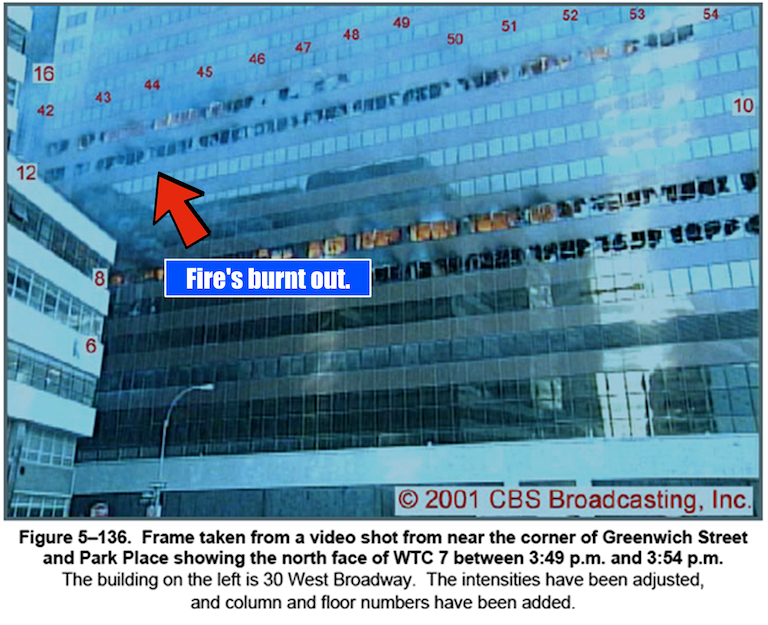
One observation that undermines the entire premise of NIST’s conclusion is this: The fires in the area where NIST claims the collapse initiated were already out at least an hour before WTC 7 went down.

burnt out fire wtc 7 768

Note the horizontally numbered exterior columns (42 through 54) and the vertically numbered floors (6 through 16) in the video frame above. Like a graph in a school textbook, you can trace with two fingers where exterior column 44 and the 12th floor meet, indicating the area where this initiating event allegedly . . . READ MORE . . .

Ukraine, 11-15-22

First, links to reports from the Associated Press, Agence France-Presse, Reuters, and National Public Radio; others are available by clicking on their names or initials below. Next, a link to a syndicated columnist’s view of Congress and continued funding for Ukraine. Then, links to three overtly partisan reports on the war. — MCM

–   –   –

Zelenskyy calls liberation of Kherson ‘beginning of the end,’ by Sam Mednick | AP  KHERSON — The retaking of Kherson after a grinding offensive that forced Russian to pull back its forces from the city was one of Ukraine’s biggest success so far of the nearly nine-month invasion and a stinging blow to the Kremlin. Zelenskyy walked the streets of the city today, just . . . READ MORE . . .

–   –   –

Kremlin says Kherson is still Russian after Zelensky visit. From AFP. MOSCOW — “We leave this without comment,” Kremlin spokesman Dmitry Peskov said today of Mr Zelensky’s visit to Kherson.. But he added: “You know, this territory is part of the Russian Federation.” Mr Zelensky . . . READ MORE . . .

–   –   –

Zelenskiy visits recaptured Kherson, says hundreds of Russian war crimes documented, by Jonathan Landay | Reuters * War crimes uncovered after Russians pulled out – Zelenskiy * Kherson residents recount abuse by Russian forces * De-mining of Kherson and power restoration underway * Fighting rages in eastern Donetsk and Luhansk regions | KHERSON, Ukraine — Ukrainian President Volodymyr Zelenskiy today visited the newly recaptured southern city of Kherson, the biggest prize yet won by Ukrainian forces, where he has accused Russian forces of committing war crimes before they fled last week. “We are moving forward,” he . . . READ MORE . . .

–   –   –

Ukrainian soldiers are picking up new skills — even from YouTube — to fight Russia. Reported by Frank Langfitt | NPR   MYKOLAIV, Ukraine — As the war has changed over the months, some Ukrainian fighters have had to adapt and learn new skills. In the first month, soldiers used shoulder-launched missiles and hit-and-run tactics to defend Kyiv. These days, they are using drones and artillery as part of a high-tech trench war in the farm fields of . . . Click HERE to listen and read.

–   –   –

The next Congress could cause Ukraine to lose the war, by Josh Rogin | The Washington Post President Biden expressed confidence Wednesday that next year’s Congress . . . will maintain robust U.S. support for Ukraine. But his certainty is not shared by many on Capitol Hill and in Kyiv. The struggle inside the GOP . . . READ MORE . . .

–   –   –

Update from Ukraine: Ruzzian airfield under fire, ambush of Ruzzians in Ukraine. Reported by Denys Davydof | DenysDavydof24h Click HERE  for illustrated video commentary from yesterday.

–   –   –

Military situation in Kherson region, Ukraine, on Nov. 14, 2022, (map update). From South Front. Click HERE for that. Click HERE for previous South Front reports.

–   –   –

Days 261, 262, 263 and 264: Ukrainian Battle Map. From Ukraine News TV. Click HERE for Nov. 11 report, HERE for Nov. 12 report, HERE for yesterday’s report, and HERE for today’s report.

Joe Lauria, 11-13-22

A movie review begins below. The movie is “Ithaca,” a documentary premiering tonight in New York City about WikiLeaks founder Julian Assange before and after he was thrown into prison on trumped up charges, and his family and friends. — MCM

–   –   –

A father fights for his son & what’s left of democracy

By Joe Lauria | Consortium News

To the extent that the media has covered the tragedy of Julian Assange at all, the focus has been on politics and the law.

Consortium News, which has provided perhaps the most comprehensive coverage of the prosecution under the Espionage Act of the WikiLeaks publisher, has also focused more on the case and less on the man.

The great issues involved transcend the individual: war, diplomacy, official deception, high crimes, an assault on press freedom and on the core of what little democracy is left in a militarized and money-corrupted system.

Assange supporters sometimes also overlook the person and concentrate instead on the larger issues at stake. Ironically, it has been Assange’s enemies and detractors who’ve long focused on the person in the worst tradition of ad hominem assaults.

He has been attacked to deflect public attention from what WikiLeaks has revealed, from what the state is doing to him and to hide the impact on freedom in the media and standards in the courtroom.

There has been a steady and organized stream of smears against Assange, from ridiculous stories about him smearing feces on Ecuadoran Embassy walls to the widely reported falsehood that he was charged with rape. That case was dropped three times before any charges were filed, but the “rape” smear persists.

These personal attacks were planned as far back as March 8, 2008 when a secret, 32-page document from the Cyber Counterintelligence Assessment branch of the Pentagon described in detail the importance of destroying the “feeling of trust that is WikiLeaks’ center of gravity.” The leaked document, which was published by WikiLeaksitself, said: “This would be achieved with threats of exposure and criminal prosecution and an unrelenting assault on reputation.”

An answer to these slurs and the missing focus on Assange as a man is “Ithaka.” The film, which makes its U.S. premiere Sunday night in New York, focuses on the struggle of Assange’s father, John Shipton, and his wife, Stella Assange, to free him.

If you are looking for a film more fully explaining the legal and political complexities of the case and its background, this is not the movie to see. The Spanish film, “Hacking Justice,” will give you that, as well as the more concise exposition in the brilliant documentary, “The War on Journalism,” by Juan Passarelli.

“Ithaka,” directed by Ben Lawrence and produced by Assange’s brother, Gabriel Shipton, humanizes Assange and reveals the impact his ordeal has had on the people closest to him.

The title comes from the poem of that name by C.P. Cavafy (read HERE by Sean Connery) about the pathos of an uncertain journey. It reflects Shipton’s travels throughout Europe and the U.S. in defense of his son, arguably the most consequential journalist of his generation.

The story begins with Shipton arriving in London to see his son for the first time behind bars after the publisher’s rights of asylum were lifted by a new Ecuadoran government leading to him being carried out of the embassy by London police in April 2019.

“The story is that I am attempting in my own … modest way to get Julian out of the shit,” Shipton says. “What does it involve? Traipsing around Europe, building up coalitions of friendship.” He meets with parliamentarians, the media and supporters across the continent. Shipton describes the journey as the “difficulty of destiny over the ease of narrative.”

He speaks to the European Parliament in Strasbourg and the German Bundestag in Berlin. In Paris, Shipton admits to supporters that “he’s not okay, but I say he’s okay not to worry people.”

He tells a Paris radio interviewer that he did not see Julian from the age of 3 until his mid-twenties, but that his mother, Christine Assange, called him “Wizzie” for wizard. Shipton tells of the earliest conversations he had with his son about secrecy that eventually led to the formation of WikiLeaks.

We learn that Julian Assange’s frustration with the inability to stop the 2003 Iraq invasion, despite the largest, worldwide anti-war protests in history, motivated him to start WikiLeaks.

The releases he published about the Iraq and Afghanistan wars, leaked by Army intelligence analyst Chelsea Manning, were published not only by WikiLeaks but by its partners at The New York Times, Der Spiegel and The Guardian, yet only Assange has been prosecuted.

The main focus of the film is the extradition hearing in Westminster Magistrate’s Court that began in February 2020 and ended in September of that year.

In the lead-up to the hearing we see . . . READ MORE . . .

Ukraine, 11-13-22

First, links to reports from the Associated Press, Reuters, National Public Radio, and Tass; others are accessible by clicking on their names or initials below. Then, via The Real News Network, a link to an interview about a new book on the war with one of its co-authors. — MCM

–   –   –

Ukrainian police, TV broadcasts return to long-occupied city, by Hanna Arhirova | AP  MYKOLAIV, Ukraine — Ukrainian police officers returned Saturday, along with TV and radio services, to the southern city of Kherson following the withdrawal of Russian troops, part of fast but cautious efforts to make the only regional capital captured by Russia livable after months of occupation. Yet one official still described the city as “a humanitarian catastrophe.” People across Ukraine awoke . . . READ MORE . . .

–   –   –

Ukraine troops greeted with flowers in Kherson after Russian retreat, by Jonathan Landay | Reuters KLAPAYA, Ukraine — Villagers holding flowers waited on the road to the southern city of Kherson to greet and kiss Ukrainian soldiers on Saturday as they poured in to secure control of the right bank of the Dnipro River after a stunning Russian retreat. The mayor said the humanitarian situation was “severe” because of . . . READ MORE . . .

–   –   –

Ukraine regains control of Kherson. Reported by Charles Maynes | NPR  After nine months of occupation, Russian forces have abandoned Kherson, Ukraine. As Ukrainians celebrated on Friday and Saturday, Russia claimed the retreat was a smart move militarily. Click HERE to listen and, now or soon, read.

–   –   –

Russia has more weapons in its arsenal for use in Ukraine, Medvedev says. From Tass. MOSCOW — Commenting on the weapons being used by Russia in its special military operation in Ukraine, Russian Security Council Deputy Chairman Dmitry Medvedev said: “For reasons that are obvious to all sensible people, Russia has not yet used its entire arsenal of weapons. Nor has it hit all possible enemy targets in localities. . . . Everything in its time.” He concluded a Telegram channel message by saying . . . READ MORE . . .

–   –   –

Book Interview. Medea Benjamin, co-author with Nicholas Davies of War in Ukraine: Making Sense of a Senseless Conflict, talks for half an hour with Chris Hedges for The Real News Network. An introduction reads: “The simple narrative of a diabolical Putin vs the freedom-loving West distorts the multifaceted, complex history of the conflict.” The conversation was conducted on or before Nov. 4. Click HERE to listen to and read a transcript.

–   –   –

MAY BE CONTINUED

Ukraine, 11-12-22

First, links to reports from National Public Radio; others are accessible by clicking on its initials below. Then, a link to an Australian observer’s view of a “Struggle for Freedom” event scheduled for next Wednesday involving former U.S. President George W. Bush and Ukrainian President Volodymyr Zelenskyy. NOTE: scroll down for the beginning of a war summary by the Berkshire Eagle’s foreign affairs writer. — MCM

–   –   –

Ukrainians are raising the country’s next generation, children now as old as the war. Reported by Elissa Nadworny | NPR  Their parents are raising the next generation of Ukrainians — children now as old as the war. Click HERE to listen and read.

–   –   –

A crash course in organ transplants helps Ukraine’s cash-strapped healthcare system. Reported by Daniel Ackerman | NPR  BOSTON —  Ukraine has long lacked a full-service organ transplant center. A crash course at Massachusetts General Hospital aims to change that. It will allow the Ukrainian doctors to open their own lung transplant center — giving patients . . . Click HERE to listen and, later, read.

–   –   –

Zelensky and Bush to give joint pro-war presentation, by Caitlin Johnstone | caitlinjohnstone.com War criminal George W. Bush and Ukrainian President Volodymyr Zelensky will be appearing at an event next week at the George W. Bush Presidential Center, in partnership with U.S. government-funded narrative-management operations Freedom House and National Endowment for Democracy. The goal of the presentation will reportedly be to address . . . Click HERE to read and listen.

Brooke, 11-12-22

The summary beginning below is by the Berkshire Eagle’s foreign affairs columnist, who as a journalist was based for about 14 years in Moscow and then Kyiv. — MCM

–   –   –

Defeats define Russia’s army

By James Brooke | The Berkshire Eagle

Russia’s army is being defined by successive defeats in the “three K’s”: Kyiv, Kharkiv and Kherson.

Last spring, Ukraine’s army and civilian volunteers stymied President Putin’s plan to decapitate Ukraine’s government in three days. The invaders were not only stopped at Kyiv’s northern suburbs, but expelled back to Belarus.

Turning on Kharkiv, Ukraine’s second-largest city, Russian forces shelled relentlessly, damaging or destroying a quarter of the housing stock in a city of 1.4 million. Ukrainians dug in their heels. By October, the invaders were expelled from the region.

Last month, Russian President Vladimir Putin took to a stage in Red Square in Moscow and declared that Kherson and three other regions in Ukraine would be part of Russia “forever.”

But on Wednesday, as Ukrainian soldiers gradually tightened the noose on Kherson City, the only provincial capital seized in the war, Russian Defense Minister Sergei Shoigu ordered on television a retreat east across the Dnipro River. A retreat would mean that the Kremlin also has given up plans to take the key Black Sea ports of Odesa and Mykolaiv.

Former Kremlin advisor Sergei Markov calls the decision to leave Kherson “Russia’s biggest geopolitical defeat since the collapse of the USSR.” WarGonzo, a pro-war Telegram account, told its 1.3 million mostly Russian subscribers that the announced withdrawal is “a black page in the history of the Russian army. Of the Russian state.”

Chairman of the U.S. joint chiefs of staff Mark Milley estimated Wednesday that Russia has up to 30,000 troops in and around Kherson City. He said: “This is going to take them days and perhaps even weeks to pull those forces south of that river.”

Ukrainian officials say that some Russian soldiers in Kherson City have changed into civilian clothes. Following a strategy adopted by the Red Army in World War II, retreating Russian soldiers have mined apartments and sewers.

Fearing a trap, Ukrainian soldiers are moving cautiously. On Thursday, they liberated 12 rural settlements, about 60 square miles.

After eight months of Russian occupation, Ukrainian collaborator are losing confidence in their future. The collaborationist administration has relocated to Skadovsk, a lowkey port city with a prewar population of 17,000.

When I vacationed there with my family two years ago, I found a peeling Black Sea resort town with a port that received only one ship that year. The Kyiv government was trying to sell the port to a Turkish buyer.

For fleeing pro-Russian administrators, Skadovsk has a big advantage. It is the closest port to Russia-controlled Crimea, about a one-hour motorboat trip across a normally placid gulf.

One administrator, Kirill Stremousov, won’t make it. On Wednesday morning, Kyrill Stremousov, deputy head of the Russian-installed regional administration, announced on his Telegram channel that the Russian military was in “full control” of Kherson. Hours later, Russian officials announced that Stremousov was killed in a car crash. President Putin quickly granted him the Order of Courage.

But there is more to Kherson Region than Kherson City.

Ukrainians face a tough fight to regain control of Kherson, a region slightly larger than Turkey. Since the 1960s, the eastern part of the region has supplied Dnipro River water to Crimea, the semi-arid peninsula jutting out into the Black Sea. Constructed from 1957 to 1963, the 250-mile long canal was hailed at the time as one of the “great construction projects of communism.’

In 2014, at the time of Russia’s takeover of Crimea, the canal was supplying as much as 85 percent of Crimea’s water. Since then, Putin stationed tens of thousands of troops on the peninsula, but did not invest in desalinization plants to obtain drinking water from the Black Sea.

Equally important to the Kremlin, Kherson region is a key part of a “land bridge” from Russia to Crimea. A 250-mile east-west road connects two Ukrainian regions controlled by Russian since 2014 — Donetsk and Crimea.

To circumvent Ukrainian control of this land route, Putin ordered the construction of a 10-mile, $3.7 billion road and rail bridge connecting Russia’s mainland with Crimea. Passing over the Kerch Strait, the bridge was personally inaugurated by President Putin on May 15, 2018.

On Oct. 8 . . . READ MORE . . .

Ukraine, 11-11-22

For now, links to reports from Reuters, Agence France-Presse, National Public Radio, the Associated Press, and Tass; others are accessible by clicking on their names or initials below. Then, reports from non-journalistic sources. — MCM

–   –   –

Strategic bridge near southern Kherson has collapsed – public broadcaster. From Reuters. KYIV — The Antonivskiy bridge, the only nearby road crossing from the southern Ukrainian city of Kherson to the Russian-controlled eastern bank of the Dnipro River, has collapsed, Ukraine’s public broadcaster quoted local residents as saying today. The Suspilne broadcaster published a photograph showing whole sections of the bridge missing. The next , , , READ MORE . . .

–   –   –

Ukraine says its forces entering Kherson after Russian retreat. From AFP. Ukraine said today its forces were entering the southern city of Kherson and hailed an “important victory” after Russia announced its troops had retreated from the only regional capital it has captured after nearly nine months fighting. The announcement . . . READ MORE . . .

–   –   –

Russia is retreating, so why is the U.S. nudging Ukraine to compromise? Reported by Greg Myre and Tom Bowman | NPR   When Russia annexed four Ukrainian regions in September, Ukrainian President Volvo __  Zelenskyy said he would never negotiate with Russian President Vladimir Putin. He made no mention of Putin in his most recent remarks, and some observers interpreted . . . Click HERE to listen and read.

–   –   –

In a major blow to Putin, Russia says it has fully withdrawn from Kherson. Reported by Rachel Martin and ACHEL MARTIN | NPR  The Russian Defense Ministry says it has completed its withdrawal from the strategically important city of Kherson in southern Ukraine. Click HERE to listen and, later, read.

–   –   –

Russia claims all troops gone from city in southern Ukraine, by Hanna Arhirova and John Leicester | AP  MYKOLAIV, Ukraine — The Russian Defense Ministry said today that it had finished pulling out its troops from the western bank of the river that divide’s Ukraine’s southern Kherson region, including the only provincial capital that Moscow had captured since invading the neighboring country. The ministry said not a single unit of military equipment was left . . . READ MORE . . .

–   –   –

Kremlin mum on decision to withdraw from Kherson. From Tass. MOSCOW — Kremlin Spokesman Dmitry Peskov did not comment on the Defense Ministry’s decision to withdraw Russian troops in the Kherson Region to the left bank of the Dnieper River, redirecting all questions on the matter to the relevant ministry. “I call on you to address the Defense Ministry for any additional . . . READ MORE . . .

–   –   –

Day 260: Ukrainian Battle Map. From Ukraine News TV. Click HERE for report for Nov. 10.

–   –   –

Military situation in southern Ukraine on NOv. 10. From South Front. Click HERE for that.

–   –   –

Ruzzia is losing 20,00o soldiers in Kherson, it may be the end, Reported by Denys Davydof | DenysDavydov24h Click HERE  for illustrated video commentary from yesterday.

–   –   –

MAY BE CONTINUED